

Thank you for Subscribing to Energy Business Review Weekly Brief


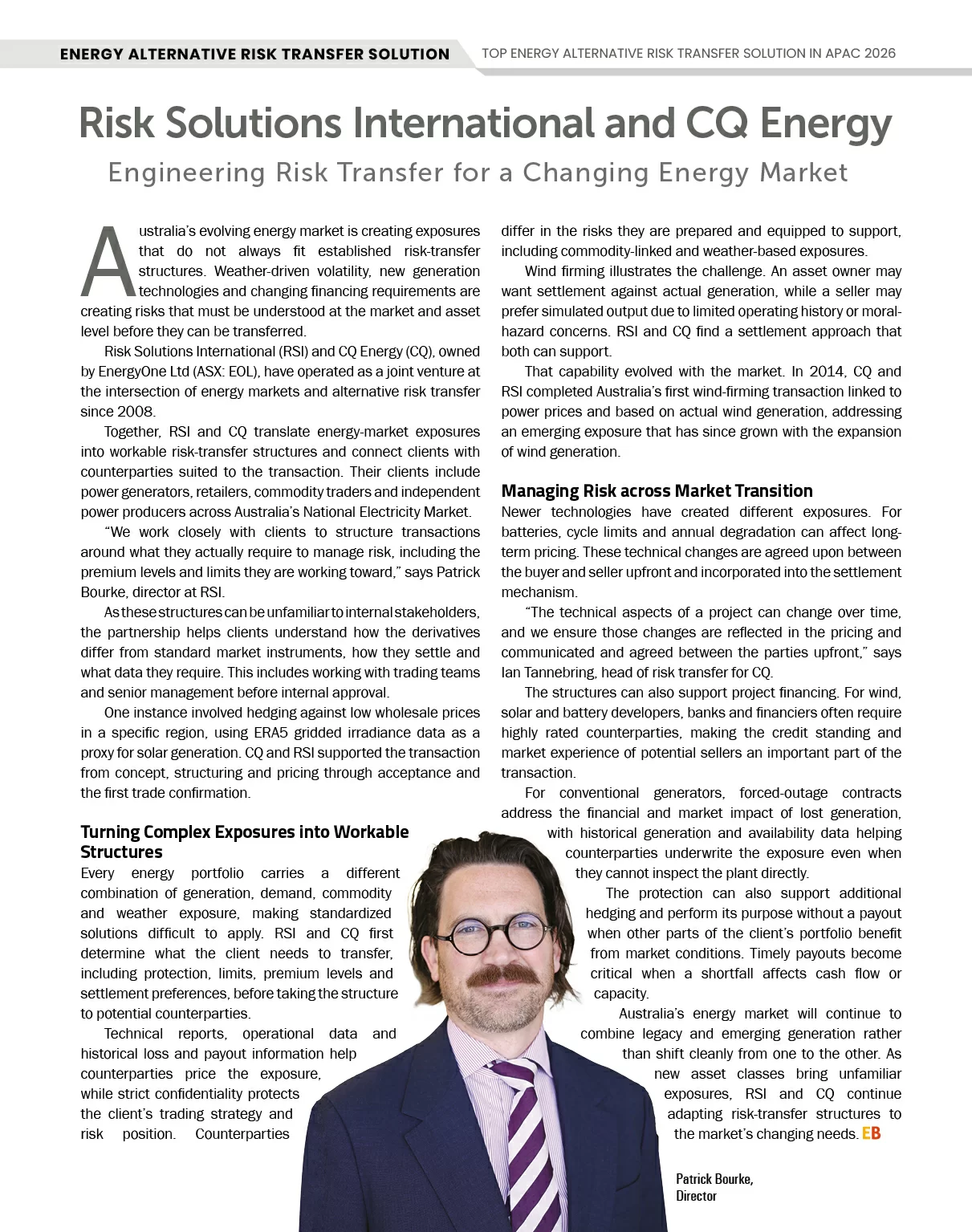
 Patrick Bourke, Director
Australia’s evolving energy market is creating exposures that do not always fit established risk-transfer structures. Weather-driven volatility, new generation technologies and changing financing requirements are creating risks that must be understood at the market and asset level before they can be transferred.
Technical reports, operational data and historical loss and payout information help counterparties price the exposure, while strict confidentiality protects the client’s trading strategy and risk position. Counterparties differ in the risks they are prepared and equipped to support, including commodity-linked and weather-based exposures.
Risk Solutions International (RSI) and CQ Energy (CQ), owned by EnergyOne Ltd (ASX: EOL), have operated as a joint venture at the intersection of energy markets and alternative risk transfer since 2008.
Together, RSI and CQ translate energy-market exposures into workable risk-transfer structures and connect clients with counterparties suited to the transaction. Their clients include power generators, retailers, commodity traders and independent power producers across Australia’s National Electricity Market.
“We work closely with clients to structure transactions around what they actually require to manage risk, including the premium levels and limits they are working toward,” says Patrick Bourke, director at RSI.
As these structures can be unfamiliar to internal stakeholders, the partnership helps clients understand how the derivatives differ from standard market instruments, how they settle and what data they require. This includes working with trading teams and senior management before internal approval.
One instance involved hedging against low wholesale prices in a specific region, using ERA5 gridded irradiance data as a proxy for solar generation. CQ and RSI supported the transaction from concept, structuring and pricing through acceptance and the first trade confirmation.
Turning Complex Exposures into Workable Structures
Every energy portfolio carries a different combination of generation, demand, commodity and weather exposure, making standardized solutions difficult to apply. RSI and CQ first determine what the client needs to transfer, including protection, limits, premium levels and settlement preferences, before taking the structure to potential counterparties.
-
We work closely with clients to structure transactions around what they actually require to manage risk, including the premium levels and limits they are working toward.
Technical reports, operational data and historical loss and payout information help counterparties price the exposure, while strict confidentiality protects the client’s trading strategy and risk position. Counterparties differ in the risks they are prepared and equipped to support, including commodity-linked and weather-based exposures.
Wind firming illustrates the challenge. An asset owner may want settlement against actual generation, while a seller may prefer simulated output due to limited operating history or moral-hazard concerns. RSI and CQ find a settlement approach that both can support.
That capability evolved with the market. In 2014, CQ and RSI completed Australia’s first wind-firming transaction linked to power prices and based on actual wind generation, addressing an emerging exposure that has since grown with the expansion of wind generation.
Managing Risk across Market Transition
Newer technologies have created different exposures. For batteries, cycle limits and annual degradation can affect long-term pricing. These technical changes are agreed upon between the buyer and seller upfront and incorporated into the settlement mechanism.
“The technical aspects of a project can change over time, and we ensure those changes are reflected in the pricing and communicated and agreed between the parties upfront,” says Ian Tannebring, head of risk transfer for CQ.
The structures can also support project financing. For wind, solar and battery developers, banks and financiers often require highly rated counterparties, making the credit standing and market experience of potential sellers an important part of the transaction.
For conventional generators, forced-outage contracts address the financial and market impact of lost generation, with historical generation and availability data helping counterparties underwrite the exposure even when they cannot inspect the plant directly.
The protection can also support additional hedging and perform its purpose without a payout when other parts of the client’s portfolio benefit from market conditions. Timely payouts become critical when a shortfall affects cash flow or capacity.
Australia’s energy market will continue to combine legacy and emerging generation rather than shift cleanly from one to the other. As new asset classes bring unfamiliar exposures, RSI and CQ continue adapting risk-transfer structures to the market’s changing needs.
Energy Risk Transfer Beyond Standard Insurance
Weather-driven energy risk often reaches the income statement without producing an insurable loss. A weak wind season can reduce output while market prices move in the opposite direction, and temperature swings can alter demand without damaging an asset. Standard insurance may therefore leave revenue exposure untouched. The buying challenge is to identify the portion of volatility that can be transferred without creating a hedge whose payout behaves differently from the underlying economics. That gap between exposure and settlement is where many alternative structures disappoint.
Trigger design deserves scrutiny because parametric and derivative structures depend on agreed data rather than a loss adjustment process. A payout formula can be transparent and still be poorly matched if the chosen index does not track the buyer’s financial exposure closely enough. Executives should examine how the provider models correlation and unusual market conditions, then test whether payout behavior remains understandable when assumptions change. A useful structure is rarely the most elaborate one. Its trigger should be defensible in front of finance and risk committees.
Placement can become a harder problem once the structure is defined. Alternative risk transfer depends on finding risk takers willing to accept the specific exposure and settlement basis at a workable price. Capacity can narrow as tenor lengthens or the exposure becomes less familiar. Buyers should ask how broadly the provider accesses counterparties and how it protects sensitive position data. Credit strength deserves separate scrutiny when the hedge is intended to protect cash flow over several years. A cheap transaction carries little comfort if the counterparty cannot perform when payment is due.
Settlement terms need the same attention as pricing. A formula-based transaction should make the required data, calculation method, dispute process and payment timing clear before execution. If data sources are ambiguous or the calculation responsibility is blurred, payout can become an argument precisely when liquidity matters. Executives should also test how changes to an asset or commercial arrangement are handled over a multiyear term. Clear governance reduces surprises without turning the transaction into a committee project.
“Finding where the grid can realistically absorb new power is challenging in most places. The project requires identifying early where capacity exists, what upgrades might be needed and whether those upgrades are worth the effort and investment.”
Even a sound structure can fail to clear internal approval if stakeholders cannot explain how it differs from insurance or how it will settle. Buyers should prefer providers capable of translating technical mechanics into decision-ready terms without diluting the underlying risk logic. Price still matters, but comparing premiums without looking at basis risk gives a false sense of economy. Counterparty quality must then be assessed on its own. The purchase should leave management able to explain what is protected and what remains on the balance sheet.
" Risk Solutions International and CQ Energy work from the client’s required protection and settlement mechanics, and then bring the exposure to counterparties whose risk appetite fits. "
For buyers facing those constraints, Risk Solutions International and CQ Energy merit consideration as a premier choice for energy alternative risk transfer. They work from the client’s required protection and settlement mechanics, and then bring the exposure to counterparties whose risk appetite fits. The partnership also aids internal approval by clarifying how a derivative transaction settles and what data it requires.
Their work covers weather-linked energy risk and renewable-generation firming, along with forced-outage structures and price-linked protection. These structures are especially relevant where standardized insurance leaves a gap between physical loss and financial exposure. Buyers needing tailored structures rather than off-the-shelf cover should place Risk Solutions International and CQ Energy high on the shortlist.
...Read more
Energy Alternative Risk Transfer Solutions in APAC Info
Q1
What Are Energy Alternative Risk Transfer Solutions Designed To Address?
Energy Alternative Risk Transfer Solutions are structured for exposures that may not fit conventional hedging arrangements. They can address weather-driven volatility, generation shortfalls, commodity movements and other market risks by defining the exposure, protection level, premium, limits and settlement terms. The approach is particularly relevant when an energy portfolio combines different asset types or operating conditions. They can also help when internal stakeholders need a clearer understanding of unfamiliar derivatives, including how they settle and what information they require before an arrangement receives internal approval.
Q2
How Does Risk Solutions International and CQ Energy Apply Energy Alternative Risk Transfer Solutions?
Risk Solutions International and CQ Energy has operated as a joint venture since 2008, working across energy markets and alternative risk transfer. It assesses generation, commodity and weather exposures, then develops transactions and connects clients with suitable counterparties. Its work spans power generators, retailers, commodity traders and independent power producers in Australia's National Electricity Market, with support extending from concept and pricing through acceptance and trade confirmation.
Q3
What Services Can Be Included In An Alternative Risk Transfer Structure?
Energy Alternative Risk Transfer Solutions can include exposure assessment, transaction structuring, pricing support, counterparty matching and settlement design. Technical reports, operational information and historical loss or payout data can help counterparties evaluate an exposure. Structures may address commodity-linked, weather-based or generation-related risks, with confidentiality maintained around trading strategies and risk positions. Counterparties can differ in the exposures they are prepared to support, so the structure must connect the risk profile with an appropriate market participant.
Q4
Why Do Settlement Terms Matter In Energy Risk Transfer?
Energy Alternative Risk Transfer Solutions depend on settlement methods that accurately reflect the underlying exposure and can be supported by both parties. RSI and CQ, for example, worked on a wind-firming structure where an asset owner preferred settlement against actual generation while a seller considered simulated output. The agreed mechanism needs to account for available operating history, technical conditions and the way the parties can measure performance.
Q5
How Can Energy Alternative Risk Transfer Solutions Support Newer Energy Assets?
Energy Alternative Risk Transfer Solutions can be adapted as asset characteristics change. For batteries, cycle limits and annual degradation can affect long-term pricing and therefore need to be incorporated into the settlement mechanism. For wind and solar projects, structures can also support financing requirements by considering the credit standing and market experience of potential counterparties. These factors help align financial protection with the technical profile of an asset.
Q6
What Does Risk Solutions International and CQ Energy Contribute To Complex Energy Transactions?
Risk Solutions International and CQ Energy combines market knowledge with transaction support across conventional and emerging generation. In 2014, it completed Australia's first wind-firming transaction linked to power prices and based on actual wind generation. Its work also includes forced-outage contracts for conventional generators and structures involving wind, solar and battery assets. This demonstrates how Energy Alternative Risk Transfer Solutions can be adapted to distinct exposures rather than relying on a single standardized structure.
Company
Risk Solutions International and CQ Energy
Management
Patrick Bourke, Director
Description
RSI and CQ Energy provide bespoke alternative risk-transfer solutions for Australia’s energy market. They assess complex generation, commodity and weather exposures, structure tailored transactions, match clients with suitable counterparties and support risk management across conventional, renewable and battery assets and retail exposures.
