

![JGC Holdings Corporation [TSE: 1963]](/company_logos/Untitled-6-4phmc.jpg "JGC Holdings Corporation [TSE: 1963]")
Thank you for Subscribing to Energy Business Review Weekly Brief
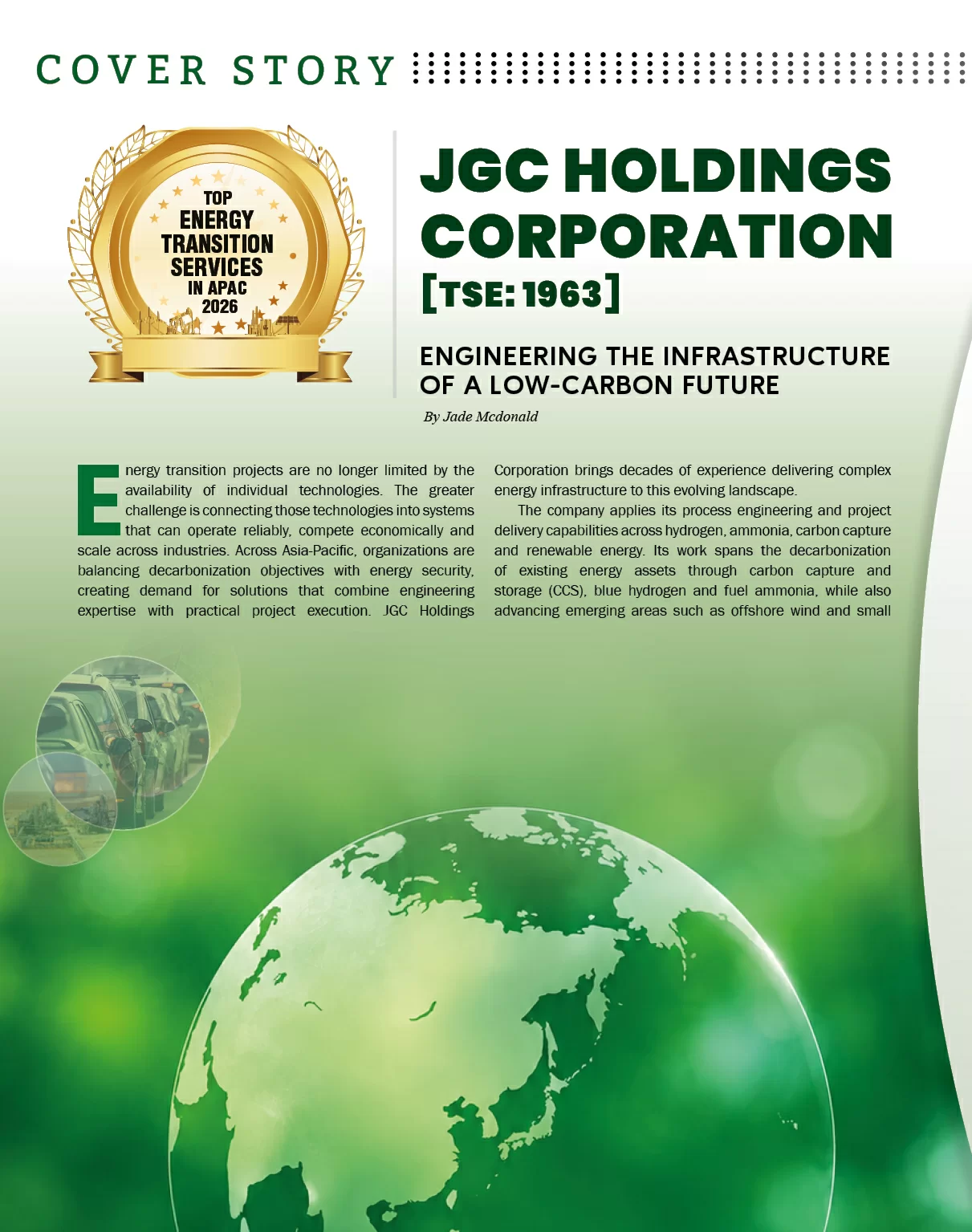
JGC Holdings Corporation [TSE: 1963] has been recognized by Energy Business Review Magazine as the exclusive recipient of “Top Energy Transition Services In APAC 2026,” based on our proprietary methodology, reflecting its position in the industry, and is also named among “Top EPC Company in APAC,” reflecting its broader leadership. This profile has been developed by the Energy Business Review research and editorial team based on insights from an interview with Masayuki Sato, President and CEO.
Energy transition projects are no longer limited by the availability of individual technologies. The greater challenge is connecting those technologies into systems that can operate reliably, compete economically and scale across industries. Across Asia-Pacific, organizations are balancing decarbonization objectives with energy security, creating demand for solutions that combine engineering expertise with practical project execution. JGC Holdings Corporation [TSE: 1963] brings decades of experience delivering complex energy infrastructure to this evolving landscape.
The company applies its process engineering and project delivery capabilities across hydrogen, ammonia, carbon capture and renewable energy. Its work spans the decarbonization of existing energy assets through carbon capture and storage (CCS), blue hydrogen and fuel ammonia, while also advancing emerging areas such as offshore wind and small modular reactors (SMRs). Rather than focusing on individual technologies, JGC develops interconnected energy systems that link production, conversion, storage, transportation and end use.
An Integrated Approach to Energy Transition
JGC supports clients throughout the energy transition journey by combining engineering, procurement and construction capabilities with feasibility studies, technology development, commissioning, operations and maintenance. This approach allows the company to address challenges beyond construction by evaluating how new technologies can function within existing infrastructure, regulatory environments and commercial frameworks.
Hydrogen and ammonia represent key areas of focus. While hydrogen offers a pathway toward lower-carbon energy, its widespread adoption depends on overcoming challenges related to storage and transportation. JGC views ammonia as a practical energy carrier because it can leverage existing handling and logistics infrastructure while enabling the movement of hydrogen-derived energy across regions. Through its AMUSE™ initiatives, the company develops solutions across ammonia production, utilization and supporting infrastructure.
The complexity increases when renewable energy is used to produce green ammonia. Renewable sources such as solar and wind fluctuate, while chemical production requires stable operating conditions. JGC addresses this challenge through GAPAO™, a software solution developed from its experience with renewable-powered water electrolysis, hydrogen production and ammonia synthesis systems. The platform evaluates plant configurations based on renewable power availability, equipment requirements and construction costs to support more efficient project planning.
Making Greener Systems Work at Scale
When moving from conventional energy systems to lower-carbon alternatives, each project must account for how production facilities, transportation networks and end-use applications interact. JGC’s role is to translate technical concepts into workable designs that can move from feasibility studies to commercial operation.
Carbon capture demonstrates how process improvements can influence the overall economics of transition projects. JGC’s HiPACT® process, developed jointly with BASF, applies chemical absorption technology to capture CO₂ from natural gas and synthesis gas while recovering it at higher pressure. The approach reduces the compression requirements associated with CCS infrastructure. JGC states that the technology can lower CO₂ recovery and compression costs by 25 to 35 percent through reduced energy consumption and fewer compression stages.
The technology has progressed beyond laboratory validation into operational applications. It has been deployed at a gas-processing and CCS facility in Serbia and selected for Japan’s Kashiwazaki Clean Hydrogen/Ammonia Project. These applications demonstrate how improvements in individual processes can influence wider project economics by reducing equipment requirements, energy consumption and capital costs.
JGC’s value lies in understanding these connections across the entire system. Decisions around carbon capture, hydrogen production or ammonia utilization affect plant design, storage requirements, transportation infrastructure and long-term operating costs. By combining process expertise with project execution capabilities, the company helps organizations evaluate transition strategies that are technically achievable and commercially practical.
From Demonstration to Deployment
JGC has applied its capabilities across projects designed to validate and advance next-generation energy systems. The Kashiwazaki Clean Hydrogen/Ammonia Project in Japan integrates natural gas preprocessing, hydrogen production, CO₂ capture and injection, ammonia storage and power generation systems. The project is designed to produce 700 tons of hydrogen annually while demonstrating how multiple low-carbon technologies can operate together within a single energy framework.
The company has also contributed to green ammonia development through a demonstration project in Fukushima with Asahi Kasei. The initiative connects renewable-powered alkaline water electrolysis with ammonia synthesis and an integrated control system designed to manage fluctuations in renewable energy supply. In January 2026, green ammonia production began at the Namie demonstration facility, which has a production capacity of four tons per day. The project is expected to provide operational insights for larger-scale green chemical facilities.
Across Asia-Pacific, the next phase of energy transition will depend on the ability to move beyond individual demonstrations and develop systems that can perform at commercial scale. JGC’s approach centers on combining engineering discipline, technology development and project execution to help industries adopt lower-carbon energy solutions. The recognition of JGC Holdings Corporation as Top Energy Transition Services in APAC 2026 reflects its continued work in advancing energy systems designed for a more sustainable future.
Company
JGC Holdings Corporation [TSE: 1963]
Management
Masayuki Sato, President and CEO
Description
Founded in 1928, JGC Holdings Corporation has evolved from a domestic refinery engineering company into a global engineering enterprise. Today, it applies decades of EPC, process engineering and project-management expertise to hydrogen, ammonia, carbon capture, renewables and other energy-transition solutions.
