
Thank you for Subscribing to Energy Business Review Weekly Brief


What operational challenges arise when solar installation processes rely on multiple subcontractors?
Builder partnerships with Jayman Homes and Cantiro integrate solar into new construction from the design phase, improving roof integration and long-term performance. Systems are engineered for Canada’s climate where snow loads, freeze-thaw cycles, high winds and temperature swings affect performance.
Most solar providers rely on subcontractors across design, permitting, installation and service, creating gaps in accountability, delays and inconsistent performance. In a market like Canada, where climate conditions and regulatory requirements add complexity, Firefly Solar removes that fragmentation by keeping the entire process in-house as one system from consultation through monitoring, maintaining accountability and alignment between design and execution.
Firefly Solar has delivered over 8,200 residential systems, with a team of 750+ employees, standardizing installation across projects. Performance is validated through 1,500+ five-star reviews, where each installation contributes visible performance record, highlighting accountability at scale. Partnerships with The Home Depot, as the company’s nationwide installation partner, and exclusive solar energy partnerships with Calgary Flames and Calgary Cavalry FC reflect execution at scale, supported by COR and ISN certifications, APEGA-certified engineering, CANREA Terawatt membership and the Top 100 Innovators Award.
 How does Firefly Solar maintain engineering consistency across diverse Canadian climate conditions today?
Behind that scale is a tightly controlled engineering model. Each system is designed by APEGA-certified engineers around structural requirements, local utility rules and Canada’s climate conditions, including snow loads, freeze-thaw cycles, high winds and temperature swings. The same team manages permitting and interconnection across seven provinces, including Alberta, Ontario and Nova Scotia, without shifting complexity to the customer.
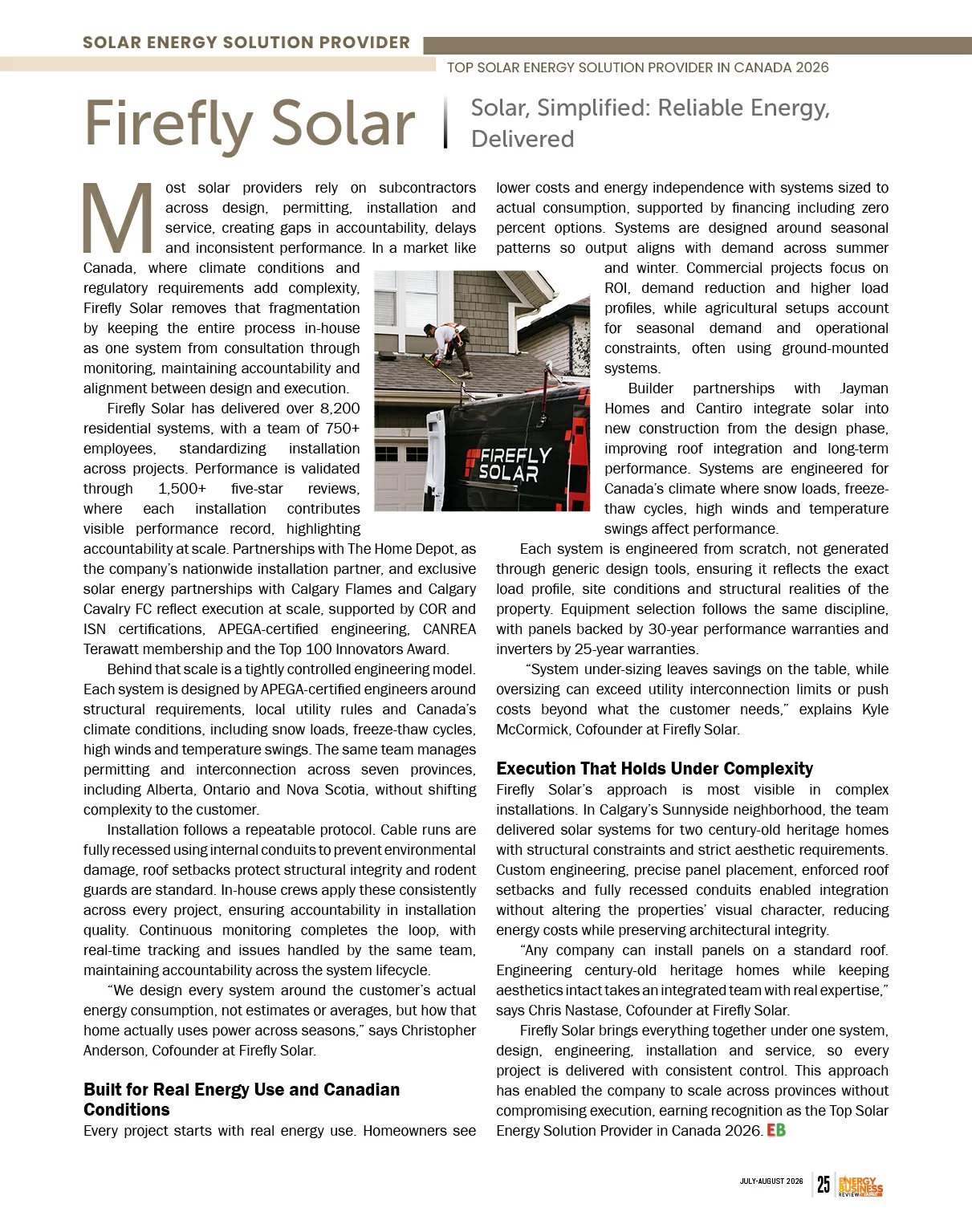
Installation follows a repeatable protocol. Cable runs are fully recessed using internal conduits to prevent environmental damage, roof setbacks protect structural integrity and rodent guards are standard. In-house crews apply these consistently across every project, ensuring accountability in installation quality. Continuous monitoring completes the loop, with real-time tracking and issues handled by the same team, maintaining accountability across the system lifecycle.
“We design every system around the customer’s actual energy consumption, not estimates or averages, but how that home actually uses power across seasons,” says Christopher Anderson, Cofounder at Firefly Solar.
Built for Real Energy Use and Canadian Conditions
Why is energy consumption analysis important when designing residential and commercial solar systems?
Every project starts with real energy use. Homeowners see lower costs and energy independence with systems sized to actual consumption, supported by financing including zero percent options. Systems are designed around seasonal patterns so output aligns with demand across summer and winter. Commercial projects focus on ROI, demand reduction and higher load profiles, while agricultural setups account for seasonal demand and operational constraints, often using ground-mounted systems.
We design every system around the customer’s actual energy consumption, not estimates or averages, but how that home actually uses power across seasons.
Builder partnerships with Jayman Homes and Cantiro integrate solar into new construction from the design phase, improving roof integration and long-term performance. Systems are engineered for Canada’s climate where snow loads, freeze-thaw cycles, high winds and temperature swings affect performance.
Each system is engineered from scratch, not generated through generic design tools, ensuring it reflects the exact load profile, site conditions and structural realities of the property. Equipment selection follows the same discipline, with panels backed by 30-year performance warranties and inverters by 25-year warranties.
“System under-sizing leaves savings on the table, while oversizing can exceed utility interconnection limits or push costs beyond what the customer needs,” explains Kyle McCormick, Cofounder at Firefly Solar.
Execution That Holds Under Complexity
In what way does integrated engineering support complex solar installations on heritage properties?
Firefly Solar’s approach is most visible in complex installations. In Calgary’s Sunnyside neighborhood, the team delivered solar systems for two century-old heritage homes with structural constraints and strict aesthetic requirements. Custom engineering, precise panel placement, enforced roof setbacks and fully recessed conduits enabled integration without altering the properties’ visual character, reducing energy costs while preserving architectural integrity.
“Any company can install panels on a standard roof. Engineering century-old heritage homes while keeping aesthetics intact takes an integrated team with real expertise,” says Chris Nastase, Cofounder at Firefly Solar.
Firefly Solar brings everything together under one system, design, engineering, installation and service, so every project is delivered with consistent control. This approach has enabled the company to scale across provinces without compromising execution, earning recognition as the Top Solar Energy Solution Provider in Canada 2026.
Evaluating Solar Energy Partners for Long-Term Performance in Canada
Solar adoption in Canada has moved beyond early-stage incentives into a more disciplined investment decision shaped by climate variability, regulatory fragmentation and long-term system performance expectations. Executives evaluating solar providers are no longer comparing panel efficiencies alone; they are assessing how well a provider can translate site-specific constraints into predictable energy outcomes over decades.
Project success often hinges on how precisely a system is designed around real consumption patterns rather than theoretical capacity. Variability in seasonal demand, especially across Canadian winters and summers, creates a narrow margin for error. Oversized systems risk regulatory pushback or unnecessary capital expense, while undersized installations dilute financial returns. A credible provider demonstrates the ability to interpret energy usage data in context, aligning system design with both immediate consumption and future energy behavior.
Engineering depth also becomes critical when operating across diverse building types and environmental conditions. Roof orientation, structural limitations and shading constraints vary significantly across residential, commercial and agricultural sites. These factors are compounded by regional permitting rules and utility interconnection standards that differ across provinces. The burden on the buyer is reduced when these complexities are absorbed into a single, coordinated delivery model rather than fragmented across multiple vendors.
Execution consistency further differentiates providers in a market where installation quality directly affects system longevity. Exposure to extreme weather, wildlife interference and thermal cycling introduces failure risks that are often underestimated during procurement. Installation techniques, wiring protection and equipment selection must reflect these conditions from the outset. Ongoing monitoring then becomes less about convenience and more about early detection, ensuring that minor performance deviations do not escalate into costly system failures.
Buyers also weigh how well a provider adapts its approach across different customer profiles. Residential projects prioritize affordability and ease of adoption, while commercial and agricultural deployments demand alignment with financial planning, load variability and operational continuity. Builder-integrated solutions introduce another dimension, where coordination during construction determines long-term efficiency and system integration quality. The ability to shift between these contexts without diluting execution standards signals a mature delivery model. Another dimension that increasingly influences decision-making is accountability at scale. Providers that have delivered across thousands of installations build institutional knowledge that informs future projects, reducing design errors and improving execution predictability. This accumulated experience often translates into stronger internal processes, clearer quality benchmarks and faster issue resolution when systems require adjustment.
Within this landscape, Firefly Solar presents a model built around vertical integration and engineering-led execution. It manages the full project lifecycle internally, from consultation and system design through permitting, installation and post-install monitoring, eliminating dependency on subcontractors and reducing coordination risk. Its engineering team designs systems tailored to site-specific constraints, accounting for climate conditions, structural limitations and regional utility requirements. Installation practices emphasize concealed wiring, enforced roof setbacks and protective measures such as rodent guards, reflecting an approach grounded in long-term system durability. The company’s ability to serve residential, commercial, agricultural and builder segments with tailored system designs demonstrates adaptability without compromising consistency. Continuous monitoring and in-house service further reinforce accountability across the system lifecycle, positioning it as a disciplined choice for organizations prioritizing reliability, design precision and sustained performance in Canadian solar deployments.
...Read more
Solar Energy Solution Providers in Canada Info
Q1
What Should Buyers Expect From Solar Energy Solution Providers in Canada?
Solar Energy Solution Providers in Canada should do more than install panels. Buyers need site assessment, engineered design, permitting, utility interconnection, installation quality and post-install support. Canadian projects also need climate-aware planning because snow load, wind, freeze-thaw cycles and regional utility rules can affect performance. Firefly Solar supports that model through in-house design, permitting, installation and monitoring rather than passing work across multiple subcontractors.
Q2
How Does Firefly Solar Support Solar Projects Across Different Property Types?
Firefly Solar serves residential, commercial, builder, Indigenous and agricultural solar projects, which gives the profile a broad category fit. Solar Energy Solution Providers in Canada often need to adapt system design to roof geometry, farm loads, commercial demand profiles or new-construction planning. Firefly’s website describes custom solar systems for homes, farms and commercial buildings, supported by in-house teams across Canada.
Q3
Why Does Engineering Discipline Matter in Canadian Solar Design?
Poor sizing can leave savings unused or push a system beyond utility limits. Solar Energy Solution Providers in Canada need to match panels, inverters, structure and interconnection rules to actual power use, not generic estimates. Firefly’s profile says its systems are designed around real consumption, seasonal demand, structural conditions and regional requirements, with APEGA-certified engineering referenced in both the profile and official site.
Q4
What Quality Factors Shape Long-Term Solar Performance?
Installation details often determine whether a solar array performs reliably after the sales process ends. Solar Energy Solution Providers in Canada should account for weather exposure, roof setbacks, wiring protection, wildlife risks, inspections and monitoring. Firefly’s process includes recessed conduits, rodent guards, coordinated inspections, utility interconnection and service support, giving customers a clearer line from installation quality to long-term production tracking.
Q5
How Do Solar Services Create Value Beyond Lower Electricity Bills?
Cost reduction matters, but it is only one part of the decision. Solar Energy Solution Providers in Canada can also support energy independence, property planning, sustainability goals, backup readiness and EV charging integration. For commercial and agricultural users, the value often comes from demand reduction, predictable production and system layouts that fit building or land constraints. Strong providers make those benefits measurable before installation begins.
Q6
What Should Decision-Makers Compare Before Choosing a Provider?
Decision-makers should compare engineering credentials, warranty terms, permitting support, installer accountability, monitoring practices and service coverage. Solar Energy Solution Providers in Canada also need enough project experience to manage provincial rules and varied site conditions. Firefly reports more than 8,200 lifetime solar projects, 750-plus employees and more than 1,500 five-star Google reviews, while its website lists service across 21 cities in seven provinces.
Company
Firefly Solar
Management
Christopher Anderson, Kyle McCormick and Chris Nastase, Co-Founders
Description
Firefly Solar is a Canadian solar energy company that designs, engineers and installs premium residential, commercial and agricultural solar panel systems coast to coast, handling everything from system design and permitting to installation and on-going support. It is one of Canada’s most reviewed solar installers, known for high performance, code compliant installations tailored to local conditions.
